

Why seek treatment for an obsessive disorder at IPITIA?
For the treatment of OCD, there is an “official therapy,” cognitive-behavioral therapy (CBT), which primarily focuses on symptom management and whose main therapeutic tool is “exposure and response prevention.”
I say it is official because it has statistical validation.
Our approach differs in that we do not focus on the symptom, because we understand it as the expression of a problem, not the problem itself. To use a physical metaphor, it’s like someone having a fever and focusing only on reducing the temperature instead of identifying the underlying cause.
That does not mean CBT doesn’t work for many people — it does.
At IPITIA, for many years, most of our patients came to us after having gone through CBT. Nowadays, and for quite some time now, we have also become a first choice for many.
On the other hand, the fact that we haven’t conducted a statistical validation doesn’t mean what we offer isn’t theoretically sound — it is based on therapeutic frameworks that have been developed over decades.
And then there are the cases of many people who have significantly improved or even completely overcome their OCD (when I say this, I mean they have been symptom-free, medication-free, and relapse-free for at least five years. I can’t guarantee it will never return, but if they follow the lifestyle we propose, it’s highly unlikely they will relapse).
So what do we do?
I appeal here to the reader’s logic and rationality to understand what I’m about to explain.
First, it’s important to get to know the person’s life story — who they are and what they have experienced.
We look for three possible types of triggering circumstances:
- Traumatic events, whether isolated or sustained over time — for example, emotionally impactful events like being physically abused.
- Long-term stressful conditions — like school bullying.
- A childhood or adolescence in a highly controlling or overprotective family environment.
We also acknowledge the possibility of a genetic predisposition in people who develop OCD, but in general, genetics predisposes, it doesn’t doom — having a predisposition doesn’t mean you are bound to suffer the disorder.
And here’s the crux of the matter: What impact did those life events have on the person’s psyche, whether they were a child, adolescent, young adult, or adult?
Because this is the key to helping resolve the underlying issue.
The fundamental question is: What did the person have to inhibit, repress, or block in order to survive psychologically?
If we can answer that, we can start developing a therapeutic action plan aimed at unlocking what causes the anxiety and the obsessive and/or compulsive symptoms.
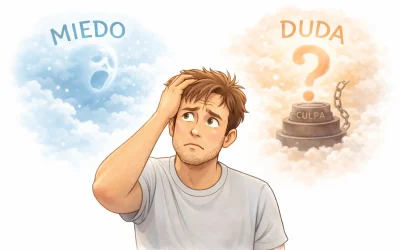
That “block” is also tied to two key emotions: fear and guilt.
Most people with obsessive disorders experience intense fear — both rational and irrational — and are highly prone to guilt.
Why? Because their bio-social position, that is, how they function in their environment, is fragile; they feel weak and extremely sensitive.
To put it simply: “We need to get them out of their mental prison and bring them back to life.”
And that is what our therapy consists of — it is highly active.
In this treatment, we will engage in dialogue, but we will rarely focus on the symptom. Personally, I almost never talk about it.
Instead, we will focus on aspects of the person’s personality, temperament, desires, and personal/professional vocation that have been “suppressed,” leading to a restricted life, in which the nervous system has no channel for expression and is stuck in a permanent loop.
That’s what we work on — to free it, not to learn how to manage it.
As for me, I was trained as a Jungian psychoanalyst and am an official member of the IAAP (International Association for Analytical Psychology). But at IPITIA I do not work from this perspective — which doesn’t prevent me from having analytic patients with other issues.
Even though Jung’s theory influences me, I work more in the line of Theodore Millon’s framework and also draw on primatology knowledge I acquired from reading the works of Frans de Waal.
To help the person break out of the obsessive-compulsive loop, we work on two core aspects:
- Self-knowledge – Above all, we want to access what is repressed or blocked.
- Activation – We propose and agree on real-life activities for the person to carry out. Always, I repeat, in mutual agreement.
I have appealed to the reader’s logic and rationality to show that there is no leap of faith in this therapy, no blind trust required.
Everything we do can be explained step by step, always adapted to the person, their specific OCD patterns, and their individual circumstances.
This is what we do — and nothing else.
That’s what has allowed us to operate as a center for eleven years, having treated hundreds of people from all over the world, some of whom have traveled long distances to work with us.
My approach is pragmatic and honest — and, for better or worse, as people often tell me, very direct.
By nature, I’m someone who, if I could help someone solve a problem in an hour (which is obviously impossible), I would.
I don’t like to beat around the bush or turn solvable problems into impossible mountains, and I’m not in favor of unnecessary suffering either.
But sometimes, especially with serious disorders like this one, time is needed.
And as I always say, the patient has only one way to evaluate a therapy: Am I getting better or not?
Based on what you’ve read, ask yourself — if you are someone struggling with OCD — whether we might be able to help you.
We will give it our all — and often, we succeed.
Julio, 2025