


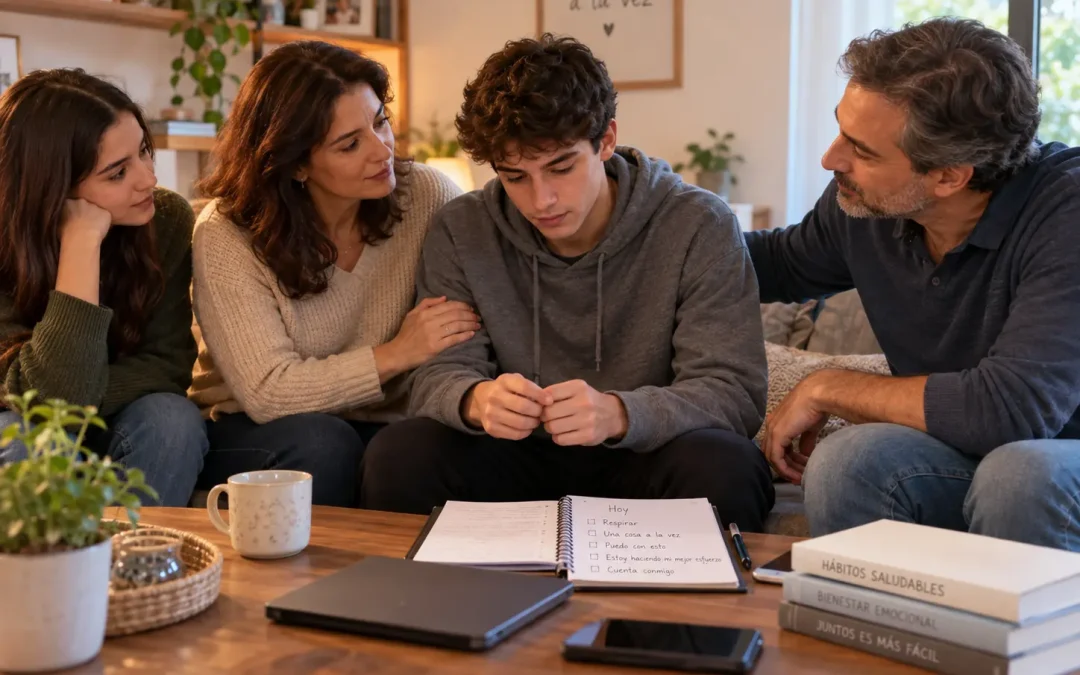
When you have obsessive-compulsive disorder (OCD), it is natural to seek support from the people you love. Obsessions can cause intense anxiety, and at certain times, needing someone to reassure you, stay with you or help you face a situation can be completely understandable. Asking for help does not mean you are weak, nor does it mean you do not want to be independent. The distress caused by OCD can be very real and, at times, difficult to face alone.
Precisely for this reason, an important part of recovery involves learning to distinguish between the help you need as a person and the help OCD needs to sustain itself.
This distinction is not always easy to make. When an obsession causes anxiety, the most immediate response is usually to try to eliminate it. You may feel the need to check, ask questions, seek confirmation or get someone to do something that allows you to feel calm again. If someone close to you responds to that need, you will probably experience relief. And that person may also feel they are doing the right thing: they love you, see you suffering and try to help.
The problem is that this relief, although real, can end up reinforcing the way the disorder operates. The compulsion reduces anxiety and, precisely because of this, increases the likelihood that it will happen again the next time a doubt arises. When other people also become involved, OCD can become part of the relationship itself.
That is why recovery does not mean you stop asking for help. It means learning to ask for a different kind of help.
Helping the person is not the same as helping the compulsion
For someone with OCD, having another person stop participating in a compulsion may initially feel like a loss. A difficult question may arise: “If you love me and know how much I am struggling, why can’t you help me?”
The answer is not that your distress does not matter. Quite the opposite. Precisely because it matters, the help you receive may need to change direction.
If someone checks a door for you, answers a doubt one more time or repeatedly assures you that what you fear has not happened, they may be giving you relief that you desperately need in that moment. But if reassurance from others becomes a condition for being able to move forward, it becomes increasingly difficult to discover that you can face uncertainty on your own.
That is why, during treatment, the people close to you may need to gradually stop participating in certain compulsions. This can be painful for you and for them. It does not mean they no longer understand you or that you have to face the disorder alone. It means they are beginning to trust that you can learn to tolerate distress without having to resolve it immediately.
Sometimes, the person who loves you most will need to be the very person who can say: “I understand that you are struggling, but I am not going to carry out this compulsion for you. I am here with you, and I trust that you can face this.”
Learning to accept that boundary is also part of your recovery.
Your recovery will require more than stopping compulsions
When we think about overcoming OCD, we usually think about reducing obsessions and compulsions. But reclaiming a life that has been shaped by the disorder for a long time involves something deeper: regaining the ability to decide how you want to live.
And this may take you into unfamiliar territory.
You may discover that you want to do things you used to avoid. You may reconnect with people, take up new activities, study, work, exercise, travel or spend more time away from home. You may begin making decisions without constantly consulting others. You may discover that you want to live differently from the way your family had imagined.
These changes are part of recovery. But they can also cause concern among the people around you.
And this is where one of the most difficult parts of the process emerges: your recovery may also require those around you to recover from the way they had become accustomed to relating to you.
Every system tends to maintain what is familiar
In psychology, the concept of homeostasis is used to describe a system’s tendency to maintain a particular balance. Families, like other human systems, develop relatively stable ways of relating over time. Each person occupies certain positions and fulfils certain roles, and although this way of functioning may not necessarily be ideal, it is familiar and predictable.
When OCD has been present for a long time, the disorder can become part of that balance.
The family learns to provide reassurance. The partner learns to anticipate needs. Parents learn when to intervene. The person with OCD learns to turn to certain people when anxiety arises. Gradually, these responses can become a habitual way of relating.
No one needs to have consciously decided that things should work this way. Everyone has simply adapted over time.
That is why, when you begin to change, the system also has to change.
And systems tend to resist change.
This does not mean your family does not want you to get better. They may deeply want you to feel better and, at the same time, feel unsettled when you begin behaving differently. They may be happy that you have fewer compulsions and feel strange when you no longer need the same things. They may be proud that you are becoming more independent and feel afraid of that independence.
The contradiction can be real.
You will need to learn to sustain your new freedom
This is probably one of the most demanding parts of recovery and, at the same time, one of the least visible.
You will not always have to struggle against OCD. At certain times, you will need to learn to stand firm in the face of other people’s reactions.
As you become more autonomous, someone close to you may ask why you go out so much, why you need to do certain activities, why you want to spend more time away from home or why you no longer do things as you used to. There may be comments that, even if they come from concern, make you question your decisions.
At those times, you will need to remember something important: someone feeling uncomfortable with your change does not mean you are doing something wrong.
Your family may need time to get used to seeing you differently. Your partner may need to learn to relate to you without OCD occupying the same space. Your parents may have to accept that you are no longer the person they needed to protect or supervise in the same way.
Understanding their feelings is compatible with standing by your decisions.
You will need to develop enough strength to tolerate the fact that your new freedom may initially cause some discomfort in others. And this can be especially difficult because you are probably not trying to distance yourself from them. You are trying to move towards a life that feels more your own.
Truly getting better may even mean losing a relationship. Or, more precisely, it means having the courage and strength to accept that risk, which may be the one that frightens you most.
Other people’s fear must not become the limit of your recovery
When someone begins to regain autonomy, those around them may feel tempted to protect them from certain decisions. This may happen because they fear the person will fail, suffer or experience something going wrong. It may also happen because it is difficult to let go of a role that has been important for years.
But recovery means gradually accepting that you cannot build a life completely free from risk, uncertainty or the possibility of making mistakes.
You will need to be able to do things without a guarantee that everything will turn out well.
And the people who love you will also need to learn to tolerate that uncertainty.
This is especially important when independence begins to become a reality. If there comes a time when you want to live on your own, make your own decisions or build a more autonomous life, your parents may be afraid. That fear deserves to be heard, but not necessarily obeyed.
Your task will not be to make them stop being afraid before you move forward. Your task will be to learn to move forward even if they need time to accept the change.
Over time, the family system will be able to reorganise around your new reality. But for that to happen, you will need to sustain it. If you return to previous patterns every time someone expresses concern, the system will naturally tend to restore the familiar balance.
A new relationship with the people who love you
Breaking the pattern that OCD has created does not mean breaking your relationships. On the contrary, it can allow those relationships to change in nature.
During a period of vulnerability, a significant part of your bond with your partner or family may have revolved around care, supervision, reassurance or managing the difficulties caused by the disorder. As you get better, that part may diminish.
At first, this may feel like a loss. But it can also become an opportunity.
Your partner can stop being someone who needs to help you control your anxiety and become someone with whom you share a life. Your parents can move away from the role of constantly protecting you and towards the role of supporting you as an adult. You will need to stop relating to them out of need and begin doing so out of choice.
This does not mean you do not need the people you love. It means you can begin relating to them from a freer position, facing their resistance.
The help you really need
That is why, during recovery, it can be useful to ask yourself what you are asking of the people around you.
If you need someone to participate in a compulsion so that you can tolerate a doubt, you are probably asking for something OCD needs. If you need someone to understand and respect you while you face that doubt without resorting to avoidance, you are asking for something that can help you regain your freedom.
The difference will not always be obvious, and you will not have to get it right every time. There will be times when you need more support and times when you can take on more responsibility.
Recovery is gradual.
But there is a direction worth maintaining: more and more help to live your life, and less and less help for OCD to keep functioning.
The people around you can be part of that process. They can learn not to respond to every request for reassurance, not to participate in certain rituals and to gradually trust your abilities. And you will need to learn to tolerate that change in the help they provide.
Recovering means becoming freer
The aim of treatment is not simply for you to have fewer symptoms. It is for you to reclaim the space OCD has occupied in your life.
And when that space becomes yours again, you may discover aspects of yourself that had been pushed into the background. Your interests may change. Your relationships may change. Your priorities may change. The way you make decisions may change.
You do not have to ask OCD for permission to do this. Nor do you have to ask permission from the people around you. You do not need everyone around you to immediately understand every change you make.
You will, however, need to learn to distinguish between maintaining relationships with the people who love you and living according to their fears.
There will be times when you need to be firm. You will need to defend your space, accept that someone is worried, tolerate someone not fully agreeing and keep moving forward. Your recovery also involves being able to build an identity of your own, independently of other people’s opinions.
The family system will need time to adapt to it. Homeostasis will tend to pull you all towards what is familiar, towards the previous ways of relating. That is why you will need to gradually sustain that change until the new situation stops being an exception and becomes the new normal.
It is not about distancing yourself from the people who love you. It is about allowing them to get to know you beyond OCD and learn to relate to a free and strong person.
And perhaps this is one of the most important parts of your recovery: understanding that you have the right to receive help, but also the right to grow. That you can need others and, at the same time, be independent. That you can listen to their fears without turning them into your limits.
Because overcoming OCD is not just about stopping certain compulsions. It is about regaining enough freedom to decide who you want to be and how you want to live. And to do that, sometimes you will need the strength and courage to sustain that new version of yourself until the people around you can see it, understand it and finally accept it.
Marco De Colle
Registered Psychologist No. 21340
Barcelona, July 2026